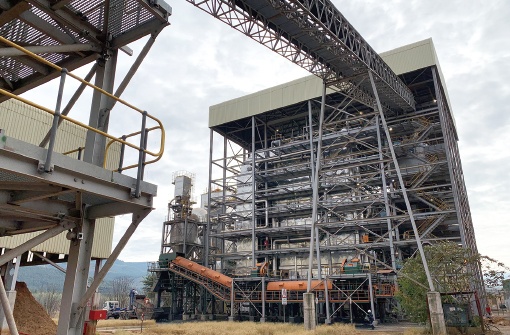
Advanced Woodchip-Fired Power Plant
Introduction
DP CleanTech delivered the complete 25MW thermal wood chip biomass power plant to Ngodwana Energy (Pty) Ltd in March 2022. The plant is adjacent to the Sappi Ngodwana Pulp and Paper Mill in Mpumalanga, South Africa and uses mill production and other biomass waste to produce 25MW of renewable electricity to the national grid, supporting the South African Government’s Renewable Energy Independent Power Producer Programme (REIPPP) to deploy 11.8 GW of large-scale renewable energy capacity by 2030. South Africa’s agriculture and forestry-based industries produce millions of tonnes of unexploited waste biomass, and recent initiatives to promote uptake of independent power production are driving renewed interest from investors, independent power producers (IPP) and international energy companies.
Plant Design
DP delivered the contract for engineering, procurement and supply of the equipment, and supervision of the installation and commissioning to EPC consortium partner KC Cottrell. Sappi Group has a 30% stake in the plant, which can consume up to 41.6 t/h of biomass fuel from surrounding plantations and mill production. With a boiler steam generation capacity of 116.4 TPH (at 105% load), the gross electric power generation capacity is 31.5MW, and a net capacity of 25MW. The project started commercial operation in March 2022 and DP is conducting additional training for operational and maintenance personnel. The plant construction and operation has boosted local employment, and the total electricity produced will support approximately 20,000 households.
Combustion Process
DP’s proprietary Water-Cooled Vibrating Grate regulates combustion, using an alternating vibration cycle of between 1.5–3 minutes for a period of 3–5 seconds at a time. Combustion air is fed to the furnace both from beneath and above the grate. The grate is divided into 3 primary air zones. The first zone is subjected to high turbulence to aid the release of volatile matter and moisture. The second stage is the pyrolysis, the third stage is for burning out. The fuel ash and slag are transported along the grate by the vibrating movement into the slag fall, then into a submerged slag conveyor, finally discharging into a slag container for disposal.
The grate was designed specifically for biomass combustion and will reliably and effectively accommodate mixtures of woody and herbaceous fuel. The vibration inhibits the formation of large slag particles, common in biomass combustion. This makes the grate suitable for burning fuels with high slagging and sintering propensities. With fewer moving parts than a standard moving grate, less maintenance is needed.
Water-Cooled Vibrating Grate
The WCVG is another feature unique to DP CleanTech. Originally from Denmark, this system was designed for the efficient combustion of biomass fuels. The grate vibrates periodically during biomass combustion, thus ensuring full burnout and controlling fuel combustion time in order to prevent slagging on the grate segments.
Boiler
High efficiency and durability are key features of DP’s products, and the design of the boiler and the materials used are fundamental to ensuring long term performance. The boiler itself is supported from the bottom, the placement of the centre of gravity and guiding devices ensures a uniform expansion in all dimensions, as well as supporting the boiler. In addition, the boiler is designed to resist earthquakes. In the event of seismic activity, any horizontal force that might affect the body of the boiler would be transmitted to its main and auxiliary steel frames, and from there to the foundations, thus preventing damage to the boiler itself. The boiler is manufactured using high grade materials to resist corrosion and extend life cycle.
Flue Gas Cleaning
DP’s advanced combustion and emissions handling techniques ensure that all gaseous plant emissions are well below regulatory standards. An electrostatic precipitator filter removes particulate matters. Fly ash is collected in a storage silo via a dense phase pneumatic transport system and can be discharged from the silo into trucks for redistribution as fertilizer. The plant is equipped with a CEMS (Continuous Emission Monitoring System) for online monitoring of emissions.